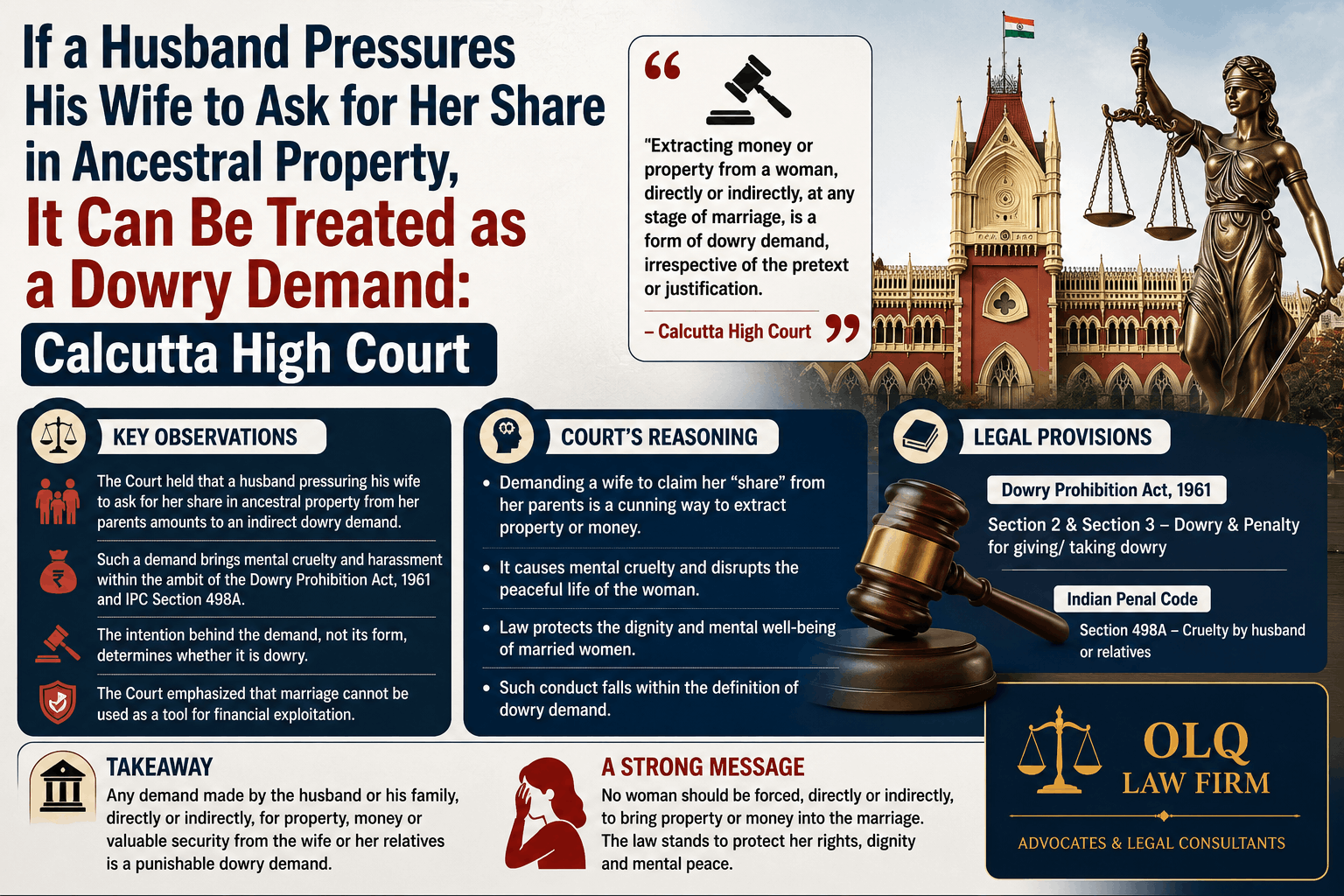
If a Husband Pressures His Wife to Ask for Her Share in Ancestral Property, It Can Be Treated as a Dowry Demand: Calcutta High Court
Can asking a wife to bring her share in ancestral property be treated as a dowry demand? The Calcutta High Court recently answered this important legal question.
If a Husband Pressures His Wife to Ask for Her Share in Ancestral Property, It Can Be Treated as a Dowry Demand: Calcutta High Court
INTRODUCTION
The Calcutta High Court’s division bench consisting of Justice Arijit Banerjee and Justice Apurba Sinha Ray in a recent and significant judgement, held that if a husband forces or pressures his wife into bringing her share in her ancestral property from her parental place, then it can amount to dowry demand under law. In the case of Sajal Parui v. State of West Bengal (CRA (DM) 183 of 2024), the court then clarified that what actually matters is not the nature of the property but the actual purpose behind the demand of property. This judgement is an important step towards strengthening legal protection in dowry related harassment and cruelty cases.
FACTS OF THE CASE
This case revolves around Sajal Parui and Chayanika. They got married on 24th April, 2010. According to the prosecution, at the time of the marriage, the bride’s family gave gold ornaments, cash, and household items to the groom and his family.
After the marriage, the couple together lived in the matrimonial house and later on gave birth to a daughter.
The prosecution said that after some time, Sajal Parui and his parents started demanding for more money from Chayanika and subjected her to physical and mental cruelty and abuse.
One important allegation was that Chayanika had repeatedly asked her brother to sell their ancestral property and to give her share of sale proceeds back to her. Evidence even showed that parts of the ancestral property had earlier been sold and Chayanika had received her share.
The prosecution claimed that she had made these requests because her husband was pressuring her to bring more money from her parental family.
On 23rd June, 2014, Chayanika and her young daughter was found hanging in their matrimonial house.
Then, two days later, her brother had logged an FIR, which lead to the registration of this case under Sections 498A, 302, 304B, and 34 of the Indian Penal Code. After some investigation, the police had filed a charge sheet under Sections 498A and 304B under IPC along with Sections 3 and 4 of the Dowry Prohibition Act.
TRIAL COURT’S DECISION
The Sessions court examined fifteen witnesses. During the trial, the defence relied upon a suicide note allegedly written by Chayanika in which she wrote that no one should be blamed for her death. A handwriting expert also stated that the handwriting matched hers.
All the accused were acquitted of the charge of murder under Section 302 IPC.
However, it convicted:
· Saraj Parui under Sections 498A and 304B IPC.
· His parents under Sections 498A and 304B read with the Section 34 of IPC.
APPEAL BEFORE THE CALCUTTA HIGH COURT
The husband challenged both his conviction and sentence before the high court. His parents also filed a separate appeal against their conviction. The main arguments raised by the appellants included:
· The FIR was lodged after two days.
· There was no specific evidence proving any dowry demand.
· Chayanika was only asking for her lawful share in the ancestral property, and that could not be treated as dowry.
· Some neighbours did not support the prosecution case.
· Several prosecution witnesses made improvements during the trial.
· The suicide note clearly stated that nobody was responsible for her death.
· Therefore, the conviction should be set aside.
CALCUTTA HIGH COURT’S DECISION
The Calcutta High Court partly allowed the appeals. The Court held that a wife’s share in her ancestral property does not prevent it from being treated as a dowry demand. If the husband forces or pressures his wife into bringing that property from her parental house, for his own benefit, then it amounts to a dowry demand under the law.
The court found the evidence that Chayanika was repeatedly pressured by her husband to bring money from her parental family. This amounted to cruelty with dowry demands.
Although the defence relied on a suicide note, the Court held that the note alone could not outweigh the evidences of the continuous harassment.
However, the Court found no clear evidence against the husband’s parents. Since the allegations against them were general and with no proof, they were acquitted.
SIGNIFICANT OF THIS JUDGMENT
This judgement makes it clear that dowry is not only limited to cash or jewellery. If a husband forces his wife to bring money or property from her parental house, including her share in her ancestral property, it can amount to a dowry demand.
At the same time, the court emphasized that family members cannot be convicted without clear evidence.
CONCLUSION
The judgement in Sajal Parui v. State of West Bengal reinforces the protection given to married women under the dowry laws. It clears that pressuring a wife to bring her share in ancestral property can equal to dowry demand.
FAQs
Contact OLQ Law Firm today for trusted legal guidance.
1. Can ancestral property be considered dowry?
Yes, if the wife is forced to bring it for her husband's benefit.
2. Were all the accused convicted?
No. The husband was convicted, while his parents were acquitted due to lack of evidence.
3. Was the husband's sentence changed?
Yes. His sentence was reduced from life imprisonment to ten years.
4. How Can OLQ Law Firm Help?
· Legal advice on dowry and matrimonial disputes.
· Representation before courts across India.
· Assistance in criminal appeals and family law matters.
· Practical and client-focused legal solutions.
Every dowry and matrimonial case deserves the right legal guidance. Let OLQ Law Firm help you seek justice with confidence.
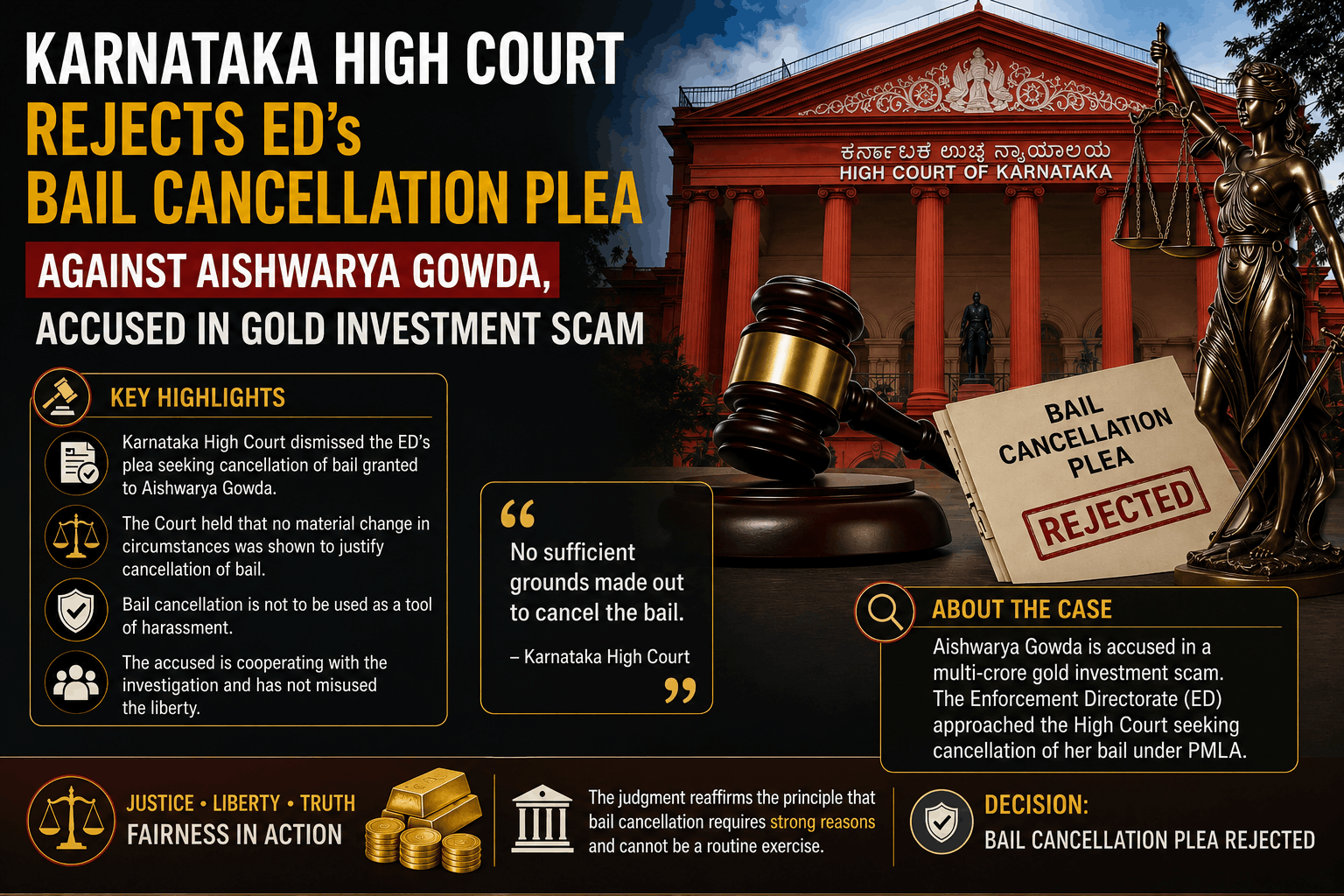


Karnataka High Court Rejects ED's Bail Cancellation Plea Against Aishwarya Gowda, Accused in Gold Investment Scam
Karnataka High Court Rejects ED's Bail Cancellation Plea Against Aishwarya Gowda, Accused in Gold Investment ScamCase de...
Supreme Court Upholds Delhi HC Order Allowing Wife To Seek Husband's Hotel, CDR Records To Prove Adultery
Supreme Court Upholds Delhi HC Order Allowing Wife To Seek Husband's Hotel, CDR Records To Prove AdulteryCase details :S...
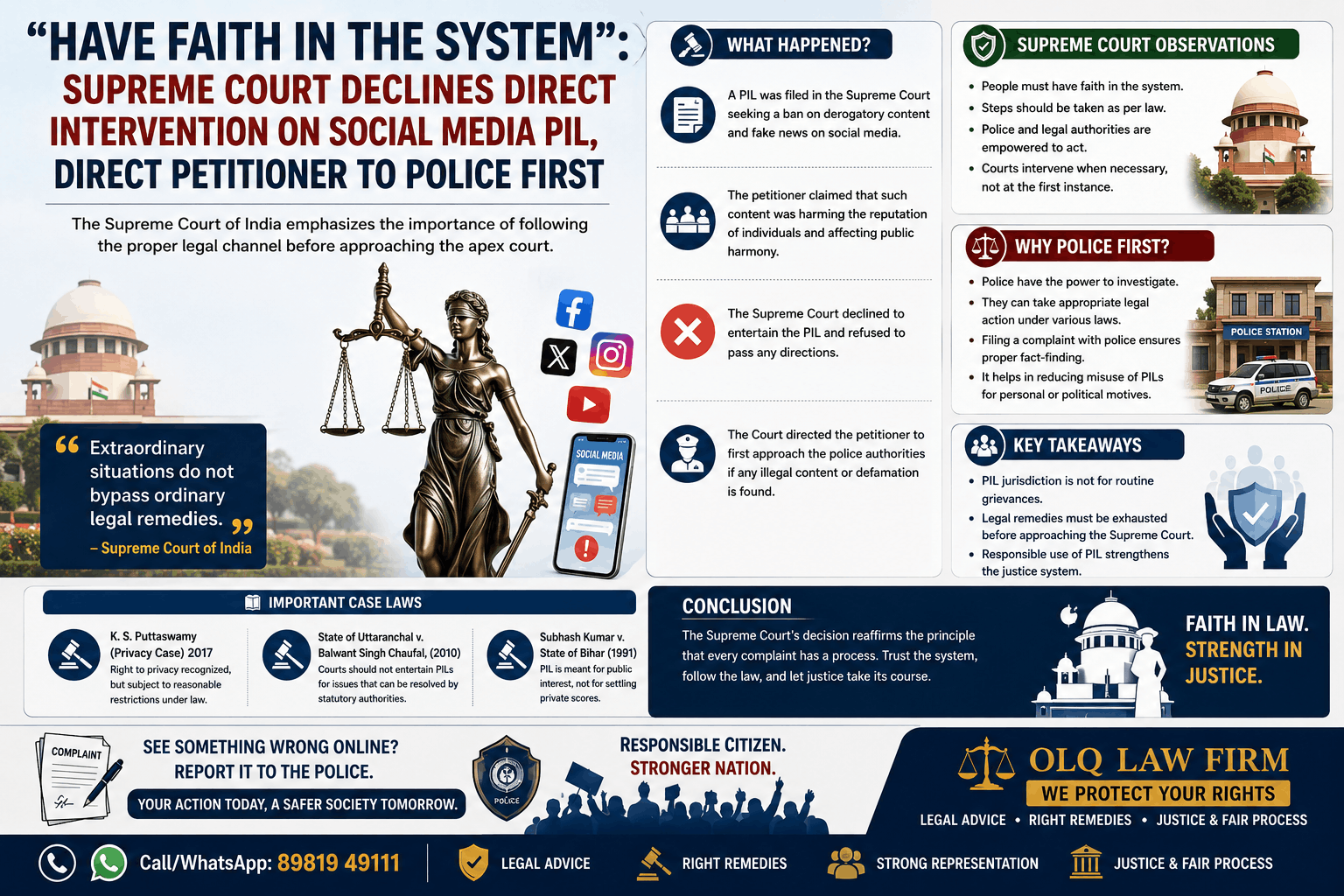
“Have Faith in the System”: Supreme Court Declines Direct Intervention on Social Media PIL, Direct Petitioner to Police First
“Have Faith in the System”: Supreme Court Declines Direct Intervention on Social Media PIL, Direct Petitioner to Police...